Last Updated: November 23, 2026
- Tinted or smoked covers that hurt legibility, and anti-camera covers, can get you a $100 fine. Colorado bars driving with a device or substance that makes any part of a plate unreadable to a camera system, including covers that change the plate’s color or are tinted enough to hurt legibility.
- Clear covers aren’t named in the statute. A clear cover still breaks the rule if it distorts the plate at an angle, changes its color, or is scratched or dirty enough to impair legibility.
- The statute doesn’t mention frames. A frame still can’t cover the month and year tabs the state issues, which must be visible at all times, and the plate must stay clearly legible.
- A plate nobody can read makes a hit-and-run driver harder to find. If that driver can’t be identified, your uninsured motorist coverage may be where your injury claim goes.
Yes, many license plate covers are illegal in Colorado. State law requires plates to be clearly legible and free from foreign materials, and it bars driving with a device or substance that makes any part of the plate unreadable to a camera system. Tinted, smoked, and anti-camera covers can fall under that ban, and a clear cover can too once it distorts the plate or gets scratched or dirty enough to impair legibility.
At CGH Injury Lawyers, based in Denver, we represent injured people, and a plate nobody can read can leave a hit-and-run victim without a driver to claim against. Call (303) 209-9395 for a free case review; there’s no fee unless we win, and your written agreement handles case expenses.
This page provides general information only and does not constitute legal advice. Reading this page does not create an attorney-client relationship. Laws vary by jurisdiction and change frequently. Always consult a licensed attorney for advice specific to your situation.
Are License Plate Covers Illegal in Colorado?
A cover is illegal when the plate no longer meets Colorado’s display rules. Both plates must be clearly legible and free from foreign materials, and no one may drive with a device or substance that makes any part of a plate unreadable to a system that automatically identifies vehicles, such as a plate camera. Tint that hurts legibility fails.
The rules are in C.R.S. 42-3-202. The owner must attach two plates to a self-propelled vehicle, one in front and one in back, except that motorcycles, autocycles, street rods, trailers, and special mobile machinery get a rear plate only.
Here’s what the statute requires of each plate:
| Requirement | Rear plate | Front plate |
|---|---|---|
| Where it goes | Horizontal, at least 12 inches off the ground measured from the bottom of the plate, at the approximate center of the vehicle, and on or within 18 inches of the rear bumper | Horizontal, in the location the manufacturer designated |
| Visibility | In a place and position to be clearly visible | Not stated separately |
| Condition | Free from foreign materials and clearly legible | Free from foreign materials and clearly legible |
| Tabs | Where the state issues tabs, the month tab goes in the bottom left corner and the year tab in the bottom right, visible at all times | None |
The owner or driver must also fasten each plate securely so it can’t swing. The rear-plate placement, visibility, and condition rules yield to the vehicle registration law or a Department of Revenue rule that authorizes something different, and the front-plate rules yield to the registration law when it does.
Under state law, driving with a cover that makes the plate unreadable to a camera system is a class A traffic infraction with a $100 fine. Other violations of the plate statute are class B traffic infractions, and the state penalty schedule lists a $15 penalty and a $6 surcharge for that section.
What About Clear Covers?
Clear covers are the gray area people ask about most. The statute doesn’t name clear covers, and no Colorado statute or state agency page we found says they’re allowed.
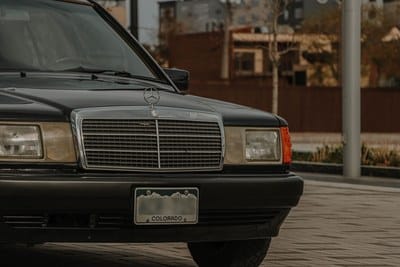 What the statute does say is that a cover breaks the rule when it “distorts angular visibility; alters the color of the plate; or is smoked, tinted, scratched, or dirty so as to impair the legibility of the license plate.” A clear cover can do any of those things over time, so the useful checks are practical ones.
Can you read every character from the side as well as straight on? Does the plate look the same color with the cover on? Is the cover free of scratches, haze, and road grime that make the plate harder to read?
Can you see both the month and year tabs in the bottom corners? If the answer to any of these is no, the cover may put you in violation of the statute, and the simplest fix is to take it off. Look at the plate from behind your car in daylight and again at night before you decide to keep the cover.
Tinted, Smoked, and Blackout Covers
These are the easy case. The statute names smoked and tinted covers that impair legibility, and a cover that changes the plate’s color is on the list whatever its tint.
A dark cover can hide the month and year tabs the state issues, which must be visible at all times. If one came on a used car you bought, take it off before your first drive. For a related equipment rule, our guide to Colorado window tint laws for drivers explains how much tint the state allows on car windows.
Are Anti-Photo License Plate Covers Legal in Colorado?
No. Colorado’s statute speaks to these products directly: a person shall not drive with “an affixed device or a substance that causes all or a portion of a license plate to be unreadable by a system used to automatically identify a motor vehicle.” That language reaches covers, sprays, films, and stickers that make a plate unreadable to plate cameras.
The penalty for that violation is a class A traffic infraction and a $100 fine. A cover that flips or retracts on command is still a device affixed to the vehicle, and it’s built to make the plate unreadable on demand.
Changing the plate itself is a different and more serious problem. Under C.R.S. 42-3-121, displaying a plate or validation tab while knowing it is fictitious or altered is a class 2 misdemeanor traffic offense.
If a driver hides the plate and then leaves the scene of an injury crash, a separate law applies.
Under C.R.S. 42-4-1601, a driver directly involved in a crash that injures or kills someone must immediately stop at the scene or as close to the scene as possible, or immediately return to the scene, and remain until giving the required information and aid. Leaving afterward to report the crash isn’t an offense, but leaving before then is a class 1 misdemeanor traffic offense if someone is injured, a class 4 felony for serious bodily injury, and a class 3 felony if someone dies. Our post on what happens after a hit-and-run in Denver covers the criminal side.
Frames Versus Covers: What Is Allowed
Colorado’s plate statute doesn’t mention frames, but a frame that makes any part of the plate unreadable to a camera system falls under the device ban just as a cover does. A frame also can’t hide the tabs the state issues or keep the plate from being clearly legible.
- Plate frames: a border around the edge of the plate. Keep it thin enough that every letter and number and both tabs in the bottom corners stay uncovered. Stand behind your car and look before you drive off with a new dealer frame.
- Plate covers: a sheet of plastic over the whole plate. Tinted, smoked, or blackout covers that hurt legibility, and anti-camera covers, run into the ban described above, and a clear cover stays out of it only while it doesn’t distort, discolor, or blur the plate.
- Wraps and vinyl overlays: material on the plate itself. Both plates must be kept free from foreign materials, and a wrap that makes any part of the plate unreadable to a camera system falls under the same ban as a cover.
- Bike racks and cargo carriers: if one blocks the rear plate, the plate isn’t in a place and position to be clearly visible. Move the plate or the rack.
A simple self-check: every character and both tabs should be readable from a car length or two behind you, day and night. The Department of Revenue can also require a plate to be replaced when that’s necessary to keep it legible.
If someone hit you and drove off and you’re not sure what coverage you have, a free case review can help you find out where you stand. There’s no fee unless we win, and your written agreement handles case expenses.
Why a Hidden Plate Matters After a Hit-and-Run
A readable plate gives police and witnesses a way to identify a driver who leaves a crash. Picture merging onto I-25 at Santa Fe when a car clips your rear quarter panel and keeps going. A witness looked at the plate, but the car had a smoked cover, and all anyone saw was a dark rectangle.
Without a plate number, police have less to work with. Colorado’s Medina Alert program, set up in C.R.S. 24-33.5-416.7, broadcasts hit-and-run suspect information through television and radio stations. It applies when someone is killed or suffers serious bodily injury, and the police agency must have more on the suspect or the vehicle, such as a complete plate number, a partial plate with the make, style, and color, or the suspect’s identity.
When the driver can’t be found, the claim may turn to your policy. Colorado auto liability policies must include uninsured motorist (UM) coverage unless the named insured rejects it in writing, so check your declarations page before you assume you don’t have it.
 UM coverage protects people insured under the policy who are legally entitled to recover damages from an uninsured driver for bodily injury, up to the policy’s UM limits. Whether a hit-and-run driver counts as uninsured depends on your policy’s wording, so read its UM section; our post on what to do when an uninsured driver hits you in Colorado walks through the first steps.
Under C.R.S. 10-4-609, Colorado law also treats a driver alleged to be at fault as uninsured for UM purposes when the driver can’t be located for service after a reasonable attempt and, in addition, either a court finds service on the driver’s insurer insufficient or ineffective after reasonable effort has failed, or the police report doesn’t show the driver’s insurer and the person trying to serve the driver doesn’t know what coverage the driver had.
Check your policy for any deadline to report a hit-and-run, and call police even when the damage looks small. On a UM claim, the adjuster works for the insurance company that would pay the claim, and our Colorado hit-and-run accident attorneys can look at the coverage you have. Kevin Cheney, our managing partner, has 25+ cases tried to verdict.
Fault still counts. Under Colorado’s comparative negligence law, C.R.S. 13-21-111, you can recover if your negligence “was not as great as” the other driver’s, and your damages are reduced by your share. If your share is equal to or greater than theirs, you recover nothing from that driver.
Here’s an example, for illustration only. Say your claim is valued at $60,000 and you’re found 10 percent at fault: your recovery drops to $54,000. Our post on what happens when the police report says you’re partly at fault explains how shared fault is argued.
Winter Grime, Toll Roads, and Plate Readers
Colorado roads give drivers three local reasons to keep a plate clean and uncovered. CDOT treats winter roads with magnesium chloride, the Front Range toll roads bill drivers by plate, and Denver Police use license plate readers. Each one is a reason to keep the plate readable.
Winter roads: CDOT’s winter treatments include magnesium chloride and an ice slicer “made of granular salt and magnesium chloride,” as its snow removal and safety page explains. The statute requires plates to be maintained free from foreign materials, so wipe the plate, and any cover on it, when you stop for gas.
Toll roads: E-470 says cameras “capture the front and rear license plates of your vehicle as it passes through a toll point,” then mails a statement to the owner at the address on file with the DMV. The Northwest Parkway photographs every vehicle and mails a bill to the registered owner. On CDOT’s Express Lanes, including corridors on I-25, US 36, and I-70, drivers without a transponder get a License Plate Toll bill sent to the registered owner.
If you don’t pay your E-470 statement in full by its due date, you’ll incur a one-time $5 late fee. After 90 days the account goes to collections with a $20 collection fee, and then a civil penalty notice adds a $25 civil penalty per notice. E-470 and CDOT’s Colorado Transportation Investment Office can also ask the Division of Motor Vehicles to place a hold on the registrations of owners who haven’t paid tolls, fees, and civil penalties.
Plate readers: Denver Police started a pilot program with the license plate reader vendor Flock in early 2024, according to the city’s announcement on license plate reader safeguards. The city credited the readers with helping police recover more than 250 stolen vehicles.
What to Do if a Driver With a Hidden Plate Hits You
If a driver whose plate nobody could read hits you, get medical care first and call police right away. Write down everything you remember about the car, including color, make, damage, and which way it went. Then ask nearby businesses whether their cameras caught it, before their footage is recorded over.
Pull your declarations page to see what UM coverage you carry, and look for any deadline in your policy for reporting a hit-and-run.
Deadlines to sue are measured in years, but footage and memories fade much sooner. Under C.R.S. 13-80-101, most tort lawsuits for bodily injury from the use or operation of a motor vehicle must be filed within three years after the cause of action accrues.
A UM claim follows a separate rule, C.R.S. 13-80-107.5, which generally gives three years after the cause of action accrues and never less, with a later deadline in some cases. Our guide to the Colorado personal injury statute of limitations covers the other time limits.
Talk to a Colorado Injury Lawyer for Free
CGH Injury Lawyers offers a free case review in English and Spanish, and there’s no fee unless we win. That covers the attorney’s fee; your written agreement handles case expenses. If a driver with a hidden or unreadable plate hit you, we’ll talk through which coverage may apply to your injuries.
Call (303) 209-9395 or tell us what happened through our contact page.
Frequently Asked Questions
Do any states allow license plate covers?
Rules vary by state. New York, for example, has barred covering a plate with glass or any plastic material since September 1, 2024, with fines of $100 to $500. Colorado’s statute doesn’t name clear covers, but it bars covers that distort the plate at an angle, change its color, or are smoked, tinted, scratched, or dirty enough to impair legibility.
Are tinted license plate covers illegal?
In Colorado, yes, when the tint impairs the plate’s legibility. The plate statute names covers that are smoked or tinted so as to impair legibility, and driving with one is a class A traffic infraction with a $100 fine. A tinted cover can also hide the month and year tabs the state issues, which must be visible at all times.
Do anti camera license plate covers work?
We haven’t found an official test that answers that. In Colorado, the statute bars driving with a device or substance that makes all or part of a plate unreadable to a camera system, and it names covers that distort the plate at an angle or change its color, so a product built to block cameras puts you at risk of a $100 fine.
Written by CGH Injury Lawyers.
Attorney Advertising. CGH Injury Lawyers.
This article is general information for Colorado injury readers. It is not legal advice, does not create an attorney-client relationship, and does not promise that any deadline, rule, or outcome applies to your case. Statute-of-limitations, comparative negligence, insurance, and compensation questions require case-specific legal review.
Related articles
-
Why Do So Many People in Denver Have Expired Tags?
Colorado gives annual registrations a one-month grace period, then charges most vehicles a late fee of $25 a month, up to $100. Here's why expired tags are common…
-
Are Traffic Cameras Legal in Colorado?
Traffic cameras are legal in Colorado, but state law limits where they ticket, what they cost and who can see the images. Here's what that means after a…
-
Why Do People Drive Slow in the Left Lane?
A slow driver camped in the left lane of a 65+ mph Colorado highway can be ticketed and can share the fault for a crash. Here's what the…