

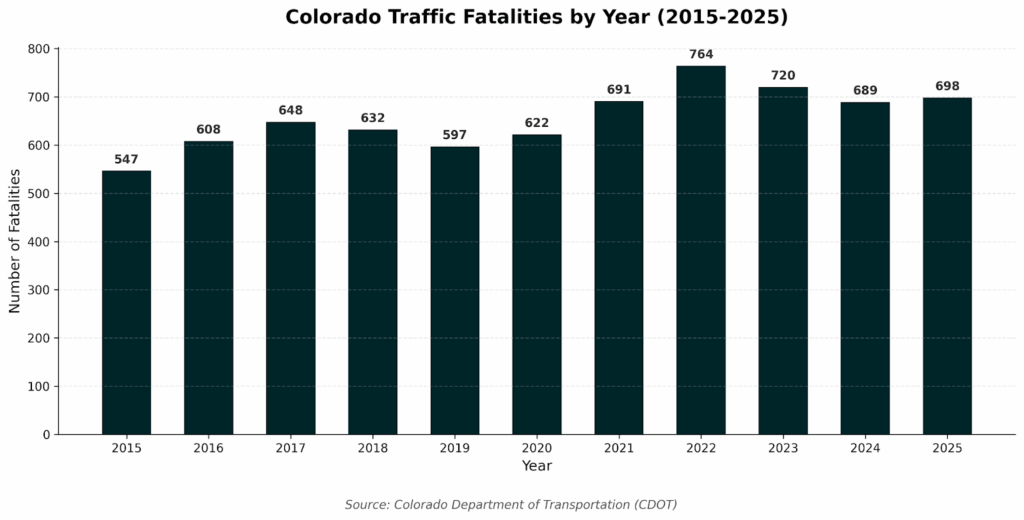
- In 2025, Colorado recorded 698 fatal crashes and 97,398 total crashes; Denver alone saw 73 fatalities and 16,211 crashes.
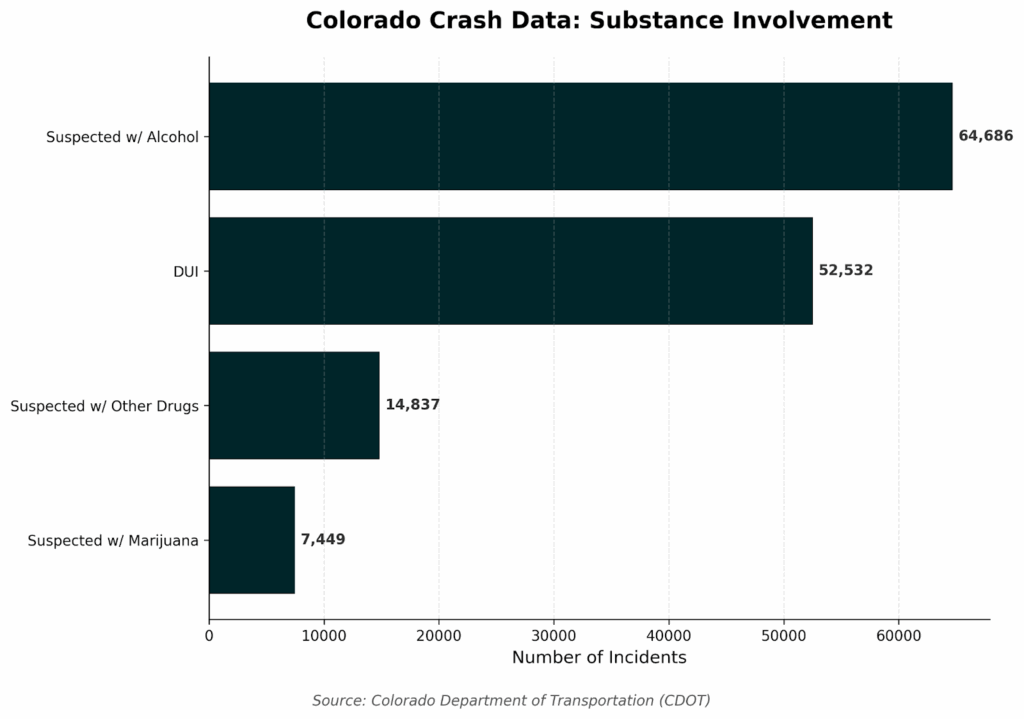
- Impairment is the leading crisis: 52,532 crashes involved DUI charges, with 64,686 suspected alcohol involvement, 7,449 marijuana, and 14,837 other drugs.
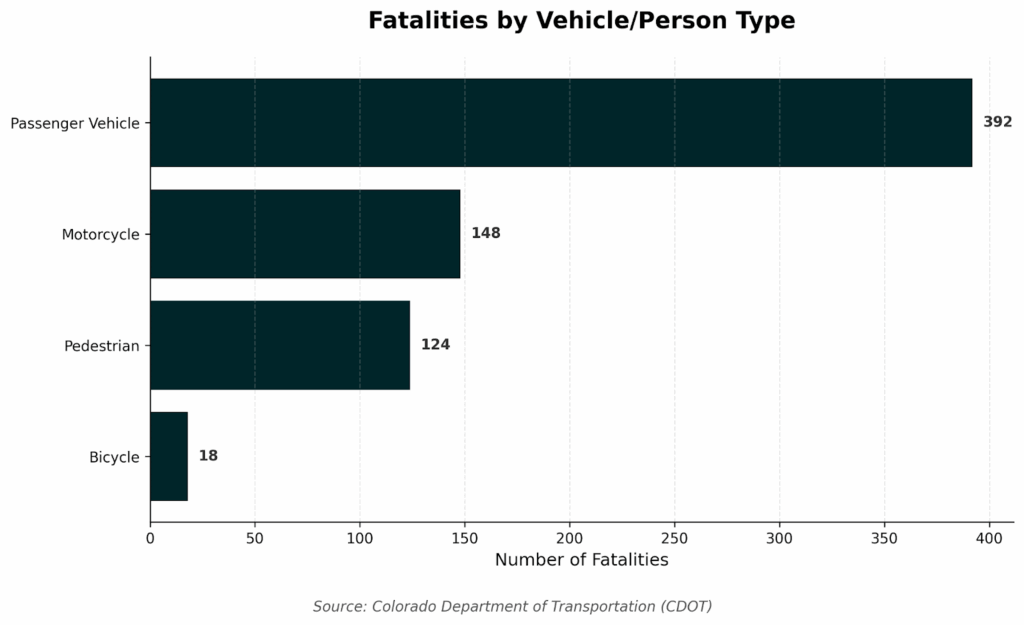
- Passenger vehicles account for most fatalities (392), but motorcyclists, pedestrians, and cyclists face disproportionately high risk.
- If an impaired or negligent driver has injured you, Colorado law allows you to pursue full compensation, including punitive damages in DUI cases.
Colorado’s roads tell a story in numbers: 97,398 crashes in 2025, 698 of them fatal. Denver alone saw 16,211 crashes and 73 deaths. These are not abstractions. They represent families disrupted, lives altered, and futures cut short. If you or a loved one has been injured on a Colorado road, understanding the data helps you understand your risk, your rights, and your path forward. Because it is more than money. It is about justice, healing, and putting your life back together.
CGH Injury Lawyers has represented injured Coloradans since 2016 from one Denver office at 2701 Lawrence Street. Kevin Cheney is Managing Partner, a member of the American Board of Trial Advocates, and Treasurer of the Colorado Trial Lawyers Association.
Colorado’s 2025 Crash Numbers: The Hard Facts
According to the Colorado Department of Transportation (CDOT), in 2025, the state registered 698 fatal crashes involving all types of motor vehicles and bicycles. Behind that number are 698 families who lost someone. From those fatal crashes, 73 fatalities occurred in Denver alone, the heart of Colorado’s most congested roadways.
But fatal crashes tell only part of the story. In 2025, Colorado recorded 97,398 total crashes, nearly 100,000 collisions in a single year. Of those, 16,211 crashes happened in Denver, where our Denver car accident lawyers see how high traffic volume, dense intersections, and distracted driving create constant collision risk.
The numbers show some progress. According to the National Highway Traffic Safety Administration (NHTSA), Colorado registered 720 fatal crashes in 2023, 6% fewer than in 2022 (764). Yet Colorado still ranks 19th nationwide in pedestrians killed in motor vehicle accidents, with 125 pedestrian deaths in 2023.
These are not just statistics. They are people: a cyclist commuting to work, a motorcyclist on a mountain ride, a pedestrian crossing Colfax Avenue, a family driving home from a ski trip. Every crash disrupts lives, physically, emotionally, financially. And if you or a loved one has been injured, understanding the data helps you understand your risk, your rights, and your path forward.
Because it is more than money. It is about justice, healing, and putting your life back together.
Sources: CDOT Fatal Crash Data | CDOT Crash Dashboard
The Impairment Crisis: Alcohol, Marijuana, and Drugs Behind the Wheel
This is where the data becomes urgent, and where the human cost is undeniable.
According to CDOT’s crash data dashboard, impaired driving is not a marginal problem in Colorado. It is a public health and safety crisis:
- 52,532 crashes involved DUI charges
- 64,686 crashes were suspected to involve alcohol
- 7,449 crashes were suspected to involve marijuana
- 14,837 crashes were suspected to involve other drugs (prescription medications, methamphetamine, opioids, and other controlled substances)
Tens of thousands of Colorado crashes each year involve a driver who chose to get behind the wheel while impaired. And these numbers likely undercount the true scope, because not every impaired driver is tested, and not every crash scene allows for toxicology analysis.
Alcohol: Still the Leading Threat
Despite decades of awareness campaigns and DUI checkpoints, alcohol remains the most common impairing substance in Colorado crashes. The 64,686 alcohol-suspected crashes span every region: late-night crashes in Denver’s LoDo district, weekend collisions on I-25, and rural highway crashes on US-285, where drivers underestimate their impairment.
Alcohol impairs judgment, slows reaction time, and increases risk-taking. A driver with a blood alcohol concentration (BAC) of 0.08%, Colorado’s legal limit, is more dangerous than a sober driver.
What this means for your claim: If you were injured by a drunk driver, liability for the car accident is typically clear. The driver’s choice to drink and drive is negligence per se, a violation of the law that establishes fault. Colorado law allows you to pursue punitive damages in addition to compensatory damages when the conduct is willful and wanton. Punitive damages punish the wrongdoer and can increase your recovery.
Marijuana: Colorado’s Unique Challenge
The 7,449 marijuana-suspected crashes reflect a growing problem. Colorado legalized recreational marijuana in 2012, and drivers often underestimate cannabis impairment or believe it is less dangerous than alcohol.
THC impairs motor skills, reaction time, and cognitive function. Colorado law sets a permissible inference threshold of 5 nanograms of THC per milliliter of blood, but THC can remain detectable for days or weeks after use, complicating legal analysis.
What this means for your claim: If toxicology shows THC in the at-fault driver’s system, your attorney must establish that the driver was actually impaired at the time of the crash, not just that they used marijuana days earlier. Insurance companies will exploit any ambiguity, so experienced representation is critical.
Other Drugs: Prescription Meds, Opioids, and Meth
The 14,837 crashes suspected to involve other drugs include:
- Prescription medications: Opioids, benzodiazepines (Xanax, Valium), sleep aids (Ambien), and muscle relaxants all carry warnings against operating vehicles.
- Methamphetamine: Meth-impaired drivers exhibit erratic, aggressive, and paranoid behavior.
- Polydrug use: Many crashes involve combinations of alcohol, marijuana, and prescription or illicit drugs.
What this means for your claim: Drug-impaired driving cases require sophisticated investigation, including blood tests, prescription records, witness testimony, and expert analysis. Insurance companies will try to muddy the waters. We investigate independently and build an airtight case.
You Deserve Justice
If you have been injured by an impaired driver, you are a victim of a preventable, reckless choice. The driver had options: a designated driver, a rideshare, a taxi. They chose to drive anyway, and you are paying the price.
You deserve full compensation for medical expenses, lost wages, pain and suffering, and permanent life changes. And if the facts support it, you deserve punitive damages that send a message.
Source: CDOT Crash Data Dashboard
Who Is Most at Risk? Fatalities by Vehicle Type
CDOT’s 2025 fatal crash data reveals stark disparities in who dies on Colorado roads. If you have lost a loved one in a fatal crash, our Colorado wrongful death lawyers can help you understand your options.
Passenger Vehicles: The Majority
392 fatalities in cars, SUVs, and trucks represent the largest category. These deaths span head-on collisions on rural highways, rollover crashes on mountain corridors, T-bone collisions at urban intersections, and rear-end car accidents. Many involve unrestrained occupants or ejection during rollovers.
Motorcyclists: Extreme Vulnerability
148 motorcycle fatalities underscore riders’ lack of physical protection. Even minor crashes can cause catastrophic injuries: traumatic brain injury, spinal cord damage, fractures, and death.
Common causes include drivers failing to see motorcycles, left-turn collisions, and road hazards. Insurance companies often blame motorcyclists, claiming they were speeding or hard to see. We counter with crash reconstruction, witness testimony, and expert analysis.
Pedestrians: Urban Tragedies
124 pedestrian fatalities make Colorado the 19th-worst state nationwide for pedestrian deaths. Most occur in urban areas, Denver, Colorado Springs, and Boulder, where drivers fail to yield at crosswalks, run red lights, or drive distracted.
Colorado law presumes pedestrians in marked crosswalks have the right of way, strengthening liability arguments.
Bicyclists: Overrepresented in Serious Injuries
18 bicycle fatalities may seem small, but cyclists are dramatically overrepresented in serious injury crashes per mile traveled. Common causes include dooring incidents, right-hook collisions, lane-sharing conflicts, and poor road conditions.
Cyclists are entitled to full compensation for medical bills, lost wages, and permanent injuries. Insurance companies will try to minimize payouts by claiming the cyclist was in the way. We fight back.
Source: CDOT Fatal Crash Data
What These Statistics Mean for Your Injury Claim
Colorado’s crash numbers are not just public health data. They shape the legal landscape for every car accident injury claim in the state.
Colorado’s Comparative Negligence Rule
Colorado follows modified comparative negligence (C.R.S. § 13-21-111): you can recover damages as long as you are less than 50% at fault. If you are 20% at fault and your damages are $100,000, you recover $80,000. If you are 50% or more at fault, you recover nothing.
Insurance companies exploit this by inflating your fault percentage. We investigate independently, consult accident reconstruction experts, and fight to minimize your fault and maximize your recovery.
Uninsured and Underinsured Motorists
Colorado has one of the highest uninsured motorist rates nationwide. Many drivers carry only the state minimum ($25,000 per person / $50,000 per accident). If your damages exceed those limits, you may need your own UM/UIM coverage.
Punitive Damages in Impaired Driving Cases
When a defendant’s conduct is willful and wanton, such as DUI, Colorado law allows punitive damages that punish the wrongdoer and deter others, increasing your recovery.
Do Not Accept a Quick Settlement
Insurance companies offer lowball settlements, hoping you will accept before understanding your claim’s true value. We do not take the insurance company’s word for anything. We investigate, document the full impact of your injuries, and fight for every dollar you deserve.
What to Do After a Colorado Motor Vehicle Accident
At the Scene:
- Check for injuries and call 911.
- Move to safety; do not leave the scene.
- Exchange information: names, insurance, license plates.
- Document: photos of vehicles, road conditions, injuries, skid marks.
- Get witness contact info.
- Do not admit fault.
In the Days After:
- Seek medical attention immediately, even if you feel fine.
- Report the crash to your insurance, but be cautious. Give only basic facts. Do not give recorded statements or sign anything without legal advice.
- Keep records: medical bills, pay stubs, pain journal.
- Do not accept a quick settlement offer.
When to Seek Legal Help:
- Serious injuries
- Disputed fault or insurance company blame
- Uninsured, underinsured, or impaired driver
- Long-term disability
- Denied claim or lowball offer
At Cheney Galluzzi & Howard, we offer a free consultation and work on contingency. You do not pay unless we win.
You Are Not Just a Case File You Deserve Justice
Colorado’s 97,398 crashes in 2025 are not just numbers. They are lives disrupted, physically, emotionally, financially. And if you or a loved one has been injured by an impaired, distracted, or negligent driver, you deserve more than a quick settlement that leaves you undercompensated.
You deserve an advocate who will stand up to insurance companies, investigate every detail, and fight relentlessly for full compensation. Because it is more than money. It is about justice, healing, and putting your life back together.
At Cheney Galluzzi & Howard, our car accident litigation team has recovered tens of millions of dollars for injured Coloradans, secured top verdicts, and earned the trust of hundreds of clients who describe us as ethical, transparent, down-to-earth, and genuinely caring. We are trial-tested, people-first, and ready to fight for you.
Contact us online for a free consultation. No upfront fees. No payment unless we win. Just honest answers and a plan to help you move forward.
Frequently Asked Questions
How many crashes happened in Colorado in 2025?
97,398 total crashes, including 698 fatal crashes. Denver recorded 16,211 crashes and 73 fatalities.
How big is the impaired driving problem in Colorado?
52,532 crashes involved DUI charges, 64,686 were suspected to involve alcohol, 7,449 marijuana, and 14,837 other drugs.
What is Colorado’s deadliest highway?
I-70, particularly the mountain corridor between Vail and Glenwood Springs.
How long do I have to file a car accident claim in Colorado?
Generally three years under C.R.S. § 13-80-101(1)(n). A shorter window applies for claims against a government entity: Colorado law requires written notice within 182 days after discovery of the injury (C.R.S. § 24-10-109). Contact an attorney early to confirm the deadline that applies to your claim.
Can I recover damages if I was partially at fault?
Yes, as long as you are less than 50% at fault under Colorado’s modified comparative negligence rule (C.R.S. § 13-21-111). Your recovery is reduced by your percentage of fault. If you are 50% or more at fault, you recover nothing.
What damages can I recover after a Colorado car accident?
Economic damages (medical bills, lost wages, future care costs) and non-economic damages (pain, suffering, loss of life quality). Punitive damages may apply in impaired driving cases where the at-fault driver’s conduct was willful and wanton.
This article is general information for Colorado injury readers. It is not legal advice, does not create an attorney-client relationship, and does not promise that any deadline, rule, or outcome applies to your case. Statute-of-limitations, comparative negligence, insurance, and compensation questions require case-specific legal review.
Related articles
-
After an Electric Scooter Accident in Denver: Your Next Steps, and Who May Pay
Seek care and a police report. Denver’s guidance after a crash on a shared scooter is to call 911 or go to urgent care if anyone is hurt,…
-
No Denver Wrongful Death Lawyer Can Tell You the Odds Here Is What They Can Tell You
Colorado’s wrongful death rules were changed by House Bill 24-1472, signed June 3, 2024 and effective January 1, 2025. Who may sue depends on whether you are in…
-
What It Really Costs to Hire a Denver Truck Accident Lawyer, Line by Line
Injury work in Colorado is usually done on a contingent fee, which ties the fee to the outcome rather than billing you up front. The rule allows a…