Personal Injury Lawyer Mountain View, CO
We Fight the “Cold Report” & Insurance Lowballs
You were hit at 44th & Wadsworth. The police didn’t come. The insurance company is blaming you. You’re not imagining it—the system failed you.
And when you called 911? They told you to “file it online.” No officer. No crash diagram. No validation.
That’s where we come in.
Cheney Galluzzi & Howard is a personal injury legal team in Denver with trial-tested experience handling car accident claims in Mountain View, Wheat Ridge, and Lakeside. We’re just minutes from your neighborhood via I-70 East, and we know these intersections like the back of our hand. More importantly, we know the law that most insurance adjusters are hoping you don’t: Colorado’s damage caps just increased in 2025 under HB24-1472, and the “Cold Report” protocol that left you without police documentation is not your fault—it’s a gap we know how to fill.
Free Consultation. No Upfront Fees. We Only Get Paid If You Win.
Proudly Serving Mountain View, Wheat Ridge & Lakeside
The Mountain View “Danger Map”: Why These Intersections Are Built to Confuse
If you live in Mountain View or commute through it, you’ve navigated the gauntlet. Here’s what the data says—and why you’re not crazy for feeling unsafe:
The Wadsworth CFI Disaster (44th & Wadsworth)
The city calls it a “Continuous Flow Intersection.” Our clients call it “Continuous Confusion.”
The hard numbers: Traffic crashes in Wheat Ridge increased by 13% in 2024 following the implementation of the new CFI traffic pattern at 44th & Wadsworth. Citations jumped by 50%. And here’s the kicker: there have been documented signal malfunctions causing lights to flash red at random, leaving drivers frozen mid-turn while cross-traffic barrels through.
If you were rear-ended, T-boned, or sideswiped at this intersection, the insurance company will try to pin it on “driver error.” We cite the 13% crash spike and the Denver Regional Council of Governments (DRCOG) traffic studies to prove that the design itself is negligent.
Sheridan Boulevard: The “Kill Zone”
DRCOG officially classifies Sheridan Boulevard as “one of the most complex, neglected, and dangerous corridors in the region.” The specific hazard? Crosswalk signals are spaced 4,000 feet apart—nearly a mile. That means if you’re walking from Clear Creek Plaza to the businesses near 38th Avenue, you either jaywalk or walk an extra 15 minutes out of your way.
If you were hit crossing Sheridan, the insurance adjuster will say you were negligent. We cite the DRCOG safety study to prove that the road design forced you into a dangerous situation. That’s not negligence—that’s a failure of infrastructure, and it’s compensable.
I-70 & Harlan Bridge Construction Zone
The $18.6 million bridge replacement project (August 2022 – February 2025) is technically wrapping up, but the “lane shifts,” faded striping, and detached sidewalk zones remain active hazards. If you hit a barrier or were rear-ended because the lane markings disappeared at the merge, that’s not a standard car accident—that’s a construction negligence case.
Construction companies have a legal duty to maintain clear signage and safe lane markings. When they fail, we hold them accountable.
The “Cold Report” Trap: What Happens When Police Don’t Show Up
Here’s the reality that most Mountain View residents discover the hard way:
Denver Police Department and surrounding metro agencies (Wheat Ridge PD, Lakeside PD) use an “Accident Alert” protocol during high-volume or weather events. Under this policy, officers will only respond to a crash scene if:
- Vehicles are undrivable and blocking traffic
- Alcohol or drugs are suspected
- There is a fatality or an injury requiring immediate ambulance transport
If you’re hurt but able to walk away, no report is filed.
The dispatcher will tell you to “file it online” with the Colorado Department of Revenue (DMV). That’s the Cold Report Trap. Without an official crash diagram, witness statements documented by police, or an officer’s narrative, it becomes your word against the other driver’s—and the insurance company will use that gap to deny or lowball your claim.
How We Fix the Cold Report Gap
When police don’t come, we become the investigators. Here’s our process:
Step 1: Immediate Evidence Collection
- Photograph all vehicle damage, skid marks, traffic signals, and road conditions
- Document weather, lighting, and visibility at the time of the crash
- Obtain contact information for any witnesses (even if they didn’t wait for the police)
Step 2: Independent Crash Reconstruction
- We hire certified accident reconstruction experts who analyze the scene, vehicle damage, and physics of the collision
- We obtain traffic camera footage, nearby business surveillance, and dashcam video
Step 3: Medical Documentation
- We connect you with doctors who understand the link between crash mechanics and injuries
- We document every symptom, every missed day of work, and every impact on your quality of life
Step 4: DMV Filing & Legal Strategy
- We ensure you meet Colorado’s DMV reporting requirements (crashes involving injury, death, or $1,000+ in damage must be reported within 60 days)
- We build a case file that’s stronger than any police report—because we know what adjusters look for, and we know how to prove fault even without an officer’s diagram
Did the dispatcher tell you to “file it online”?
Don’t let the Cold Report ruin your case. Call us at (720) 209-5290 within 24 hours of your crash. We’ll walk you through evidence collection and protect your right to compensation—even without a police report.
The 2025 Legal Shift: What Your Case Is Actually Worth Now (HB24-1472)
Here’s the information most insurance adjusters are banking on you not knowing:
Colorado’s personal injury damage caps just increased on January 1, 2025, under House Bill 24-1472. Most billboard firms and local generalists haven’t updated their websites yet. They’re still quoting 2023 numbers. That means they’re undervaluing your case—and so is the insurance company.
The New Damage Caps (Effective 2025):
Non-Economic Damages (Pain & Suffering): $875,000
- This is up from approximately $600,000 under the old caps
- Covers physical pain, emotional distress, loss of enjoyment of life, and disfigurement
- Applies to car accidents, truck crashes, slip and falls, and other personal injury claims
Wrongful Death: $2.125 Million
- Covers loss of companionship, loss of guidance, and the emotional devastation of losing a loved one
The caps will continue to rise incrementally over the next five years, adjusted for inflation. But right now, in 2025, your pain and suffering are worth $875,000—not the $250,000 the adjuster offered you last week.
Why This Matters for Mountain View Residents
Insurance companies train their adjusters to lowball claims in the first 30 days after an accident, hoping you’ll take a quick settlement before you realize:
- Your injuries are more serious than you thought
- You’re missing more work than anticipated
- The law changed, and your case is worth more
We don’t take the insurance company’s word for anything. We calculate the full value of your case using the 2025 caps, and we fight to get you every dollar you’re owed under the new law.
Legal Services We Provide in Mountain View
How We Handle Personal Injury Cases in Mountain View
We know you’ve never worked with a lawyer before. Most of our clients haven’t. Here’s exactly what happens when you hire Cheney Galluzzi & Howard:
Phase 1: Free Consultation (No Obligation)
We listen. You tell us what happened, and we tell you whether you have a case. No legal jargon. No pressure. Just honest answers.
Phase 2: Investigation & Evidence Building
We take over the fight with the insurance company so you can focus on healing. We:
- Obtain medical records and bills
- Interview witnesses and obtain surveillance footage
- Hire experts (accident reconstructionists, medical specialists, economists)
- File all necessary reports with the DMV and insurance carriers
Phase 3: Demand & Negotiation
We send a detailed demand letter to the insurance company, backed by evidence, medical documentation, and the new 2025 damage caps under HB24-1472. We negotiate aggressively, and we don’t settle for lowball offers.
Phase 4: Trial (If Necessary)
Most cases settle, but we prepare every case as if it’s going to trial. That’s what “trial-tested” means. Our founding partner, Kevin Cheney, has taken 25+ cases to verdict and recovered tens of millions of dollars for injured Coloradans. He serves as Treasurer of the Colorado Trial Lawyers Association (CTLA) and sits on the Board of Governors for the Colorado Bar Association (CBA). When insurance companies see his name on the case, they know we’re not bluffing.
We work on contingency. That means no upfront fees, no hourly bills, and no payment unless we win your case.
Serving Mountain View & Surrounding Neighborhoods
We’re based in Denver, just a 10-minute drive east on I-70 from Mountain View. We proudly serve families and commuters throughout:
- Mountain View (the 12 Blocks between Sheridan & Wadsworth)
- Wheat Ridge (especially near 44th Ave & Wadsworth CFI)
- Lakeside (I-70 corridor and Sheridan Blvd)
- Applewood (West 32nd Ave & Youngfield)
- Edgewater (Sheridan & 20th Ave)
Directions from Mountain View to Our Denver Office
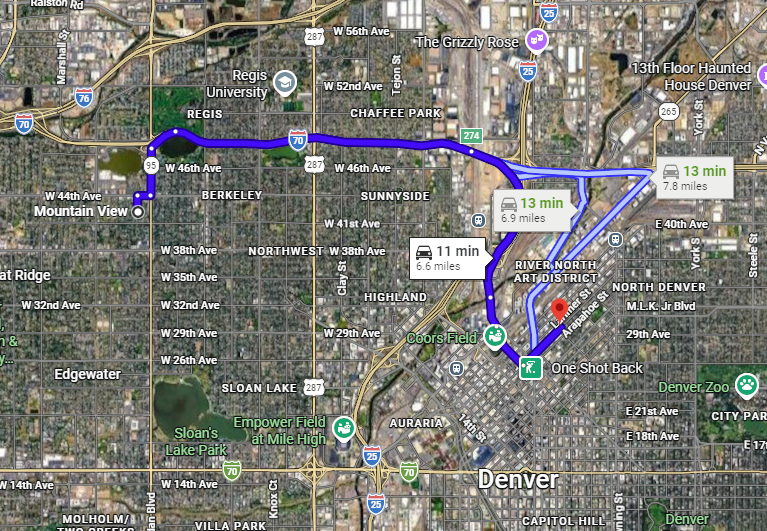
From the heart of Mountain View (near Clear Creek Plaza):
- Head east on 44th Avenue
- Merge onto I-70 East toward Denver
- Take Exit 276B (Federal Blvd / Lowell Blvd)
- Turn right onto Federal Blvd
- Our office is at [Denver Address] with free parking available
Total drive time: 10-12 minutes
We also offer phone consultations and can meet you at your home or a location near you if travel is difficult due to your injuries.
Why Mountain View Residents Drive to Denver for Cheney Galluzzi & Howard
We don’t have a Mountain View office, and we’re honest about that. But here’s why families in the 12 Blocks make the short drive to Denver for representation:
Trial-Tested Experience: 25+ trials to verdict, tens of millions recovered
Legislative Expertise: Kevin Cheney is CTLA Treasurer—he doesn’t just follow the law, he helps write it
Hyper-Local Knowledge: We know 44th & Wadsworth, Sheridan Blvd, and the I-70 construction zones Updated Legal Strategy: We use the 2025 HB24-1472 damage caps, not outdated 2023 numbers
Cold Report Expertise: We fill the evidence gap when police don’t respond
People-First Philosophy: It’s more than money—it’s about rebuilding your life
Legislative Expertise: Kevin Cheney is CTLA Treasurer—he doesn’t just follow the law, he helps write it
We’re 10 minutes away. The billboard firms are everywhere. But when it comes to trial-tested representation that fights for the full value of your case, the drive is worth it.
What Your Neighbors Are Saying
Mountain View families trust Cheney Galluzzi & Howard because we’re ethical, transparent, and down-to-earth. We don’t act like a billboard firm. We act like neighbors who happen to be really good trial lawyers.
Common Questions About Personal Injury Claims in Mountain View, CO
What if the police didn’t come to my accident scene?
You’re not alone. The “Cold Report” protocol means police often don’t respond unless there’s a fatality, DUI, or undrivable vehicles. We fill that gap by conducting our own investigation, hiring crash reconstruction experts, and building evidence the police didn’t collect. You must file a report with the Colorado DMV within 60 days if your crash involved injury or $1,000+ in damage.
What if I was partially at fault for the accident?
Colorado uses a modified comparative negligence. You can still recover compensation as long as you’re less than 50% at fault. For example, if your damages are $100,000 and you’re found 20% at fault, you can still recover $80,000. Insurance companies will try to inflate your fault percentage to reduce their payout. We fight to minimize your fault and maximize your recovery.
How much is my case worth?
It depends on your injuries, lost wages, medical bills, and pain and suffering. Under the new 2025 damage caps (HB24-1472), non-economic damages (pain & suffering) are capped at $875,000, and wrongful death claims are capped at $2.125 million. We calculate the full value of your case and fight for every dollar.
How long do I have to file a claim?
In Colorado, the statute of limitations for personal injury claims is 2 years from the date of injury. For auto accidents specifically, it’s 3 years. But don’t wait—evidence disappears, witnesses forget, and insurance companies use delays against you. Call us as soon as possible.
Do I have to pay anything upfront?
No. We work on contingency, which means we only get paid if we win your case. No upfront fees. No hourly bills. No hidden costs.
What if the insurance company already made me an offer?
Don’t sign anything without talking to us first. Insurance adjusters are trained to lowball claims in the first 30 days, hoping you’ll settle before you realize the full extent of your injuries or the new value of your case under HB24-1472. Once you sign a release, you can’t go back. Let us review the offer—for free—before you make a decision.
Take the First Step: Free Consultation
You’re hurt. Confused. Scared. Maybe the insurance company is already blaming you. Maybe you’re wondering if you even have a case.
You do. And we have your back.
Call Cheney Galluzzi & Howard for a free, no-obligation consultation. We’ll review your case, explain your options in plain English, and tell you exactly what we can do to help. No upfront fees. No pressure. Just honest answers from a Denver personal injury law firm that knows Mountain View, knows the law, and knows how to fight.
2701 Lawrence St, Suite 201, Denver, CO 80205 – Just 10 minutes east via I-70