Last Updated: November 10, 2026
- Colorado requires an adequate muffler and bans cut-offs and bypasses. Taking the muffler out, or changing the exhaust so it’s louder than the original muffler, breaks the state muffler statute.
- The muffler statute judges a car by three tests, with no decibel number. The car must have an adequate muffler in constant operation, and it must be kept up to prevent “excessive or unusual noise.” It can’t have a cut-off or bypass, and no change can make it louder than its original muffler.
- A muffler violation is a class B traffic infraction. Colorado’s penalty schedule lists $15 plus a $6 surcharge, and the general class B range is $15 to $100. A class B infraction carries no license points.
- A modified exhaust can turn into a fault argument after a crash. The other driver’s insurer may use it to claim you were partly to blame. Colorado’s comparative negligence rule then lowers your recovery by your share of fault and bars it once your share reaches 50 percent in a two-driver crash.
Yes, if the car lacks an adequate muffler in constant operation that’s kept up to prevent excessive or unusual noise, or is equipped with a cut-off, bypass, or similar device. It’s also illegal for anyone to modify an exhaust in a way that makes it louder than the original muffler. Those rules come from subsection (1) of Colorado’s muffler statute, and the muffler and cut-off rules cover every motor vehicle that must be registered and is driven on a highway.
The statute doesn’t give a decibel number for a car; its muffler rule speaks of “excessive or unusual noise.” A loud exhaust can also come up after a crash, when the other driver’s insurer may look for ways to shift fault onto you.
CGH Injury Lawyers, based in Denver, offers a free crash case review at (303) 209-9395, or you can tell us what happened online.
This page provides general information only and does not constitute legal advice. Reading this page does not create an attorney-client relationship. Laws vary by jurisdiction and change frequently. Always consult a licensed attorney for advice specific to your situation.
What Colorado’s Muffler Law Says
Under C.R.S. 42-4-225, every motor vehicle that must be registered and is driven on a highway needs an adequate muffler in constant operation. It must be kept up to prevent excessive or unusual noise. The law also bans cut-offs and bypasses, and it bars any change that makes the exhaust louder than the original muffler.
Subsection (1) of the statute does four things, quoted here word for word:
- It requires “an adequate muffler in constant operation and properly maintained to prevent any excessive or unusual noise.”
- It says no muffler or exhaust system “shall be equipped with a cut-off, bypass, or similar device.”
- It bars modifying the exhaust “in a manner which will amplify or increase the noise emitted by the motor of such vehicle above that emitted by the muffler originally installed on the vehicle.”
- It says the original muffler “shall comply with all of the requirements of this section.”
The statute defines a muffler as a device of chambers, baffle plates or another mechanical design that receives exhaust gas and is “effective in reducing noise.” The section doesn’t apply to electric motor vehicles.
The muffler statute sets no decibel limit for cars. A different statute, C.R.S. 25-12-107, holds a vehicle noise table that cities and counties may adopt. It lists limits only for vehicles rated at 6,000 pounds or more and for motorcycles apart from low-power scooters.
California does write a number into its law. One subdivision of its Vehicle Code section 27151 says an exhaust system on a vehicle with a manufacturer’s gross vehicle weight rating under 6,000 pounds, apart from a motorcycle, complies at 95 dBA or less when tested under the most current SAE International standard.
Denver’s city code has a noise chapter too. The city’s summary of its noise ordinances says Chapter 36 applies to “some motor vehicle noise,” without saying which kinds.
Music from a car falls under a different part of Denver’s code. The city’s noise summary says Section 38-89 covers “sound amplifying equipment in or on motor vehicles,” and that Denver police enforce it.
The city health department adds a narrower point. After describing the city’s ban on compression engine brakes, its noise program page says, “Other vehicle-related noises are not covered by the Denver noise ordinance and not enforceable by DDPHE.”
The state muffler statute applies in Denver as it does across Colorado.
Is Muffler Delete Illegal in Colorado?
In general, yes. A muffler delete takes the muffler out, so the car lacks the adequate muffler that C.R.S. 42-4-225 requires, even if it’s quiet at idle. Because the statute defines a muffler as a device “effective in reducing noise,” removing it also runs into the ban on making the exhaust louder than the original.
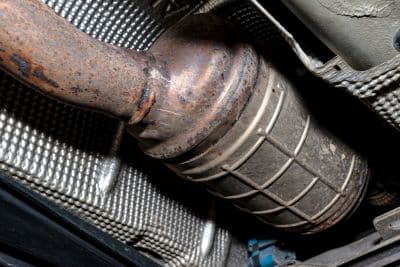 A straight-pipe job that also removes the catalytic converter adds a federal problem. The EPA’s vehicle tampering policy lists three-way catalysts among emissions control devices. For a car already sold, it cites the Clean Air Act’s ban “for any person knowingly to remove or render inoperative any such device or element of design after such sale and delivery to the ultimate purchaser.”
Not every exhaust change breaks the muffler statute, which sets three tests: a vehicle that must be registered and is driven on a highway needs an adequate muffler in constant operation, kept up to prevent excessive or unusual noise, and no cut-off, bypass, or similar device, and no one may modify an exhaust in a way that makes it louder than the original muffler. Common changes line up against those tests this way:
- A cat-back or axle-back system that keeps an adequate muffler in constant operation, properly maintained to prevent excessive or unusual noise, has no cut-off, bypass, or similar device, and is no louder than the original muffler fits all three tests.
- A resonator delete keeps the muffler, but it still breaks the statute if it makes the car louder than the original muffler.
- A valved exhaust can count as a “cut-off, bypass, or similar device” if opening the valve lets exhaust skip the muffler.
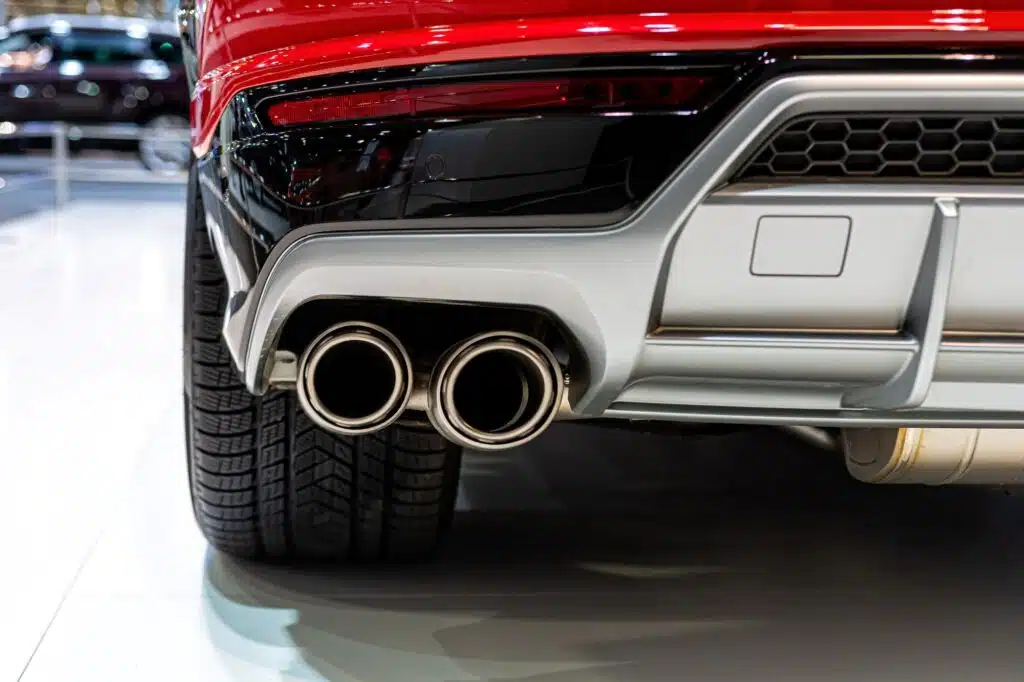
- A muffler delete, cutout, or straight pipe fails the statute on its face.
Motorcycles are covered too. Colorado’s definitions section, C.R.S. 42-1-102, defines a motorcycle as “a motor vehicle,” so aftermarket pipes on a bike face the same muffler rules.
Can Cops Stop You if Your Exhaust Is Too Loud?
 Yes. Under C.R.S. 42-4-203, uniformed police officers, “at any time upon reasonable cause,” may require a driver to stop and submit the vehicle and its equipment to an inspection. A loud exhaust can be that reasonable cause, so you don’t have to be doing anything else wrong first.
If a C.R.S. 42-4-203 equipment inspection finds the required equipment “is not present or is not in proper repair and adjustment,” the officer may give a written notice and issue a summons. That summons is a misdemeanor traffic offense with a $100 fine, which drops to $5 if the owner makes the repair within 30 days and brings a law enforcement officer’s certification of the repair to court. A ticket written under the muffler statute itself, C.R.S. 42-4-225, is different, and this table shows what it carries.
| Item | What Colorado law says |
|---|---|
| Charge | A violation of the muffler rule is a class B traffic infraction under C.R.S. 42-4-225(3). Colorado law says a traffic infraction “constitutes a civil matter.” |
| Amount | The penalty schedule in C.R.S. 42-4-1701 lists $15 plus a $6 surcharge for this violation. The general range for a class B infraction is $15 to $100. |
| Points | The same statute says the state licensing department “has no authority to assess any points” upon judgment for a class B traffic infraction. |
Denver police run a dedicated Street Racing Enforcement Team. Denver7 reported this on September 4, 2026, in its story on Denver police changing street racing enforcement, and CBS Colorado reported it on August 3, 2026. Neither report breaks out how many of the team’s citations were for exhaust or noise.
Do You Have to Pull Over for Emergency Vehicles if You Can’t Hear the Siren?
Yes. A loud exhaust doesn’t excuse missing an emergency vehicle. Under C.R.S. 42-4-705, you must yield when one approaches “making use of audible or visual signals,” so flashing lights alone trigger the duty, even if you never hear the siren.
Our post on how loud your car stereo can legally be in Colorado covers the C.R.S. 42-4-705 yield duty for drivers playing loud music. When an emergency vehicle approaches, that statute says you must pull over as close as possible to the right-hand edge or curb, clear of any intersection. You must then stop until it passes, unless a police officer directs otherwise.
What a Modified Exhaust Means After a Colorado Crash
A modified exhaust can give the other driver’s insurer a reason to blame you for part of the crash. Colorado’s comparative negligence rule then cuts your recovery by whatever share of fault you’re assigned. When only two drivers are involved, you recover nothing once your share reaches 50 percent.
Under C.R.S. 13-21-111, you can still recover when your fault “was not as great as the negligence of the person against whom recovery is sought,” but the award drops in proportion to your share.
Take a hypothetical $100,000 claim:
- Found 20 percent at fault: your recovery drops to $80,000.
- Found 50 percent at fault in a two-driver crash: you recover nothing.
 Under Colorado’s modified comparative negligence rule, a muffler delete can hand the other side an easy story. The story goes: this driver modifies cars, drives hard and couldn’t hear the horn. A story like that isn’t proof of what caused the crash.
Colorado measures fault by each person’s negligence, so the question is what each driver did, such as who ran the light or changed lanes.
CGH’s Denver car accident lawyer page explains how a claim with disputed fault works, and the case review is free.
Colorado’s comparative fault rule also applies when a driver with a loud exhaust hits you. Say a straight-piped truck drifts into your lane, and the driver says you should have heard him coming. His drift is still weighed as his negligence.
Will a Muffler Delete Pass Emissions in Colorado?
A delete that also removes emissions equipment can’t pass in Denver. Denver is in the emissions program area that C.R.S. 42-4-304 defines, and there an emissions certificate can’t be issued to a vehicle showing signs of tampering with its emissions controls. That makes a removed catalytic converter a problem at test time as well as under federal law.
Under C.R.S. 42-4-310, a certificate of emissions control “shall not be issued for vehicles in the program area exhibiting smoke or indications of tampering with or poor maintenance of emissions control systems.” That rule is about emissions equipment, while the muffler statute covers noise.
The program area, where the regular test in our post on Colorado’s vehicle emissions requirements applies, is defined in C.R.S. 42-4-304 to cover:
- Adams, Arapahoe, Boulder, Douglas, El Paso, Jefferson, Larimer, and Weld counties, plus the cities and counties of Broomfield and Denver.
- Minus portions of Adams, Arapahoe, El Paso, Larimer, and Weld that the statute marks off by creeks, roads, and survey lines.
- Subject to areas the State Air Quality Control Commission could exclude by a rule adopted by the end of 2011.
The state DMV’s title and registration manual lists the counties for gasoline vehicles. Its enhanced program covers Boulder, Jefferson, Broomfield, Denver, Douglas, and parts of Adams, Arapahoe, Larimer and Weld. It lists El Paso only for the diesel program.
What Are the Lawsuit Deadlines After a Colorado Crash?
Most Colorado crash lawsuits must be filed within three years after the claim accrues, and a claim against a public entity needs written notice within 182 days. Neither deadline changes because of how your car sounded or what was done to the exhaust.
- Lawsuits: C.R.S. 13-80-101(1)(n) sets the three-year limit. It covers tort actions for bodily injury or property damage from the use or operation of a motor vehicle.
- Government claims: the notice rule covers a claim against a public entity or one of its employees on the job, such as a city driver. Under C.R.S. 24-10-109, the 182 days run from the date you discover the injury.
How to Answer Questions About a Modified Exhaust After a Crash
If the other side brings up your exhaust after a crash, don’t hide the modification. Gather the paperwork for any exhaust work, such as shop receipts or parts invoices. With those records, you can show exactly what was changed and when.
- Photograph the car, exhaust included, before any repair or change.
- Keep the ticket and any court paperwork, if you got one.
- Hold off on a recorded statement to the other driver’s insurer until you’ve talked with someone on your side. Adjusters may try to inflate your share of fault, a pattern covered in the insurance adjuster trap.
If you were hurt in a crash anywhere in Colorado, call CGH Injury Lawyers at (303) 209-9395. The review is free, in English or Spanish, and there’s no fee unless we win. That covers the attorney’s fee, and your written agreement handles case expenses.
Frequently Asked Questions
Is muffler delete illegal in Colorado?
In general, yes. Colorado’s muffler law requires every motor vehicle that must be registered and is driven on a highway to have an adequate muffler kept up to prevent excessive or unusual noise. It also bans cut-offs and bypasses.
A muffler delete removes the muffler, so it fails the muffler requirement on its face. If the catalytic converter comes out too, there’s an emissions problem as well. In Colorado’s program area, a vehicle that shows signs of tampering with its emissions controls can’t get an emissions certificate.
Can cops stop you if your exhaust is too loud?
Yes. Colorado lets uniformed police officers with reasonable cause stop you and inspect your car’s equipment.
A muffler violation is a class B traffic infraction. Colorado’s schedule lists $15 plus a $6 surcharge, within a general class B range of $15 to $100. The violation carries no license points.
What is the loudest legal exhaust?
Colorado’s muffler statute doesn’t set a decibel number for passenger cars, so no single setup is the loudest legal one. The limit is the car’s original muffler, because the statute bars any exhaust change that makes the car louder than the muffler originally installed. A straight pipe or muffler delete doesn’t meet that standard.
Written by CGH Injury Lawyers.
Attorney Advertising. CGH Injury Lawyers.
This article is general information for Colorado injury readers. It is not legal advice, does not create an attorney-client relationship, and does not promise that any deadline, rule, or outcome applies to your case. Statute-of-limitations, comparative negligence, insurance, and compensation questions require case-specific legal review.
Related articles
-
How Loud Can You Play Music in Your Car in Colorado?
Last Updated: November 10, 2026 Table of Contents Denver’s Plainly Audible Rule and Colorado’s Noise Table What a Loud Music Stop Looks Like in Denver Is a 1000W…
-
Is It Illegal to Have Sex in a Self-Driving Car in Colorado?
Last Updated: November 6, 2026 Table of Contents Which Kind of Self-Driving Car Do You Mean? Is It Illegal to Have Sex in Your Car? In a Tesla…
-
What Injury Pays the Most for a Car Accident in Denver? What Really Drives the Number
Last Updated: November 10, 2026 Table of Contents Which Car Accident Injuries Usually Lead to the Largest Claims? The Three Kinds of Losses Colorado Counts Why Medical Bills…